
Trends
Societal and economic trends
On the one hand, prospects for the car parking market are favourable. The population is still growing and urbanisation continues. In the countries where we are active, the number of cars is still increasing. Research shows that these cars are parked somewhere for an average of 23 hours a day. This creates opportunities for Q-Park's continued growth.
At the same time, the recession is making its presence felt. Consumer confidence is still low but new favourable forecasts for economic growth have a stimulating influence. Unemployment is high and that has an adverse effect on the population's purchasing power and willingness to buy. Decreasing business activity also results in vacant office buildings. The number of parking season tickets at existing offices is decreasing; at new office developments, full occupation is less often a matter of course.
Even though the economy is showing some signs of recovery, a slight rise in unemployment is expected in 2014. The highest unemployment levels are reported in Ireland (12½%, but declining) and France (11%, stable). Germany (5%) and Norway (3½%) report the lowest unemployment.
Until half way through 2013, retail turnover declined slightly (by about 1%), but by the end of the year was more or less back at the level of 2012, Eurostat reports. The Netherlands and Belgium still remain substantially behind the European average (-4%). Great Britain, France and Sweden are doing better than the average (+2%). As a result, in many countries the number of people visiting shopping centres is declining. Yet, people keep coming, albeit with a different purpose. Now that the volume of internet sales continues to increase, the distinction between doing essential shopping quickly and fun shopping in combination with online shopping is becoming clearer. In the future, there will be a combination of offline and online shopping, resulting in an overall understanding of what shops have to offer (retailers also offer customised online orders).
Multifunctional cities with a pleasant environment and a wide range of amenities, shops and culture will continue to attract the general public in large numbers. The difference with cities that do not have this offering is becoming greater.
Demographic developments have considerable consequences for society. Consistently low fertility rates, combined with longevity and the fact that the baby boomers are reaching retirement age, mean the population is ageing. The number of people of working age is declining, while the number of elderly people is increasing. The social and economic changes associated with the ageing population have far-reaching implications, both at national and regional levels. This concerns a wide range of policy areas, with consequences for healthcare, labour market participation, social security and public finances.
“Today parking is about so much more than storing cars. It’s central to the creation of livable, walkable communities. It’s about cars, bikes, mass transit, mobility and connecting people to places.”
Shawn Conrad, CAE Executive Director International Parking Institute
Developments in the car parking market
- Cooperation between government bodies and private parties is a prerequisite to keep inner-city areas accessible through well thought-out parking policy. Parking policy drives mobility habits, research shows.
- Local authority finances are under pressure. Parking revenues and fines are becoming an increasingly important source of income everywhere in European cities. This increases the willingness of municipalities to work together with serious partners in search of a balanced policy.
- Parking is increasingly becoming a part of integrated services. Customers book an experience such as a concert or festival including parking. For us this means that we, together with partners, can offer a service for all parts of their trip and programme.
- The digitalisation of information continues. More and more, reliable, real-time parking information is becoming available. Information about prices and availability is on mobile devices. This reduces environmentally-unfriendly traffic cruising for a place to park and is more pleasant for visitors, who can then find a parking space more quickly.
- Digital parking control and payment for on-street parking spaces based on the vehicle registration number are becoming increasingly common. People parking start a parking transaction by entering their number plate at a payment machine or by using their smartphone. The advantage for customers is the ease of payment and paying for the actual parking time in arrears, just as in purpose-built parking facilities. This means that the diversity of payment options between on-street parking and parking in a car park or an off-street parking facility is diminishing.
- Digitalisation of parking based on number plate meets some resistance because of privacy sensitivity: it is possible to track and register parking movements. In a car park, customers have more freedom to choose whether or not they will identify themselves.
- Customers expect parking facilities to be open 24/7, so that they can use them at any time, day or night.
- Increasing necessity for better customer service.
- Need for parking facilities that have a better appearance.
- Need to improve safety in car parks.
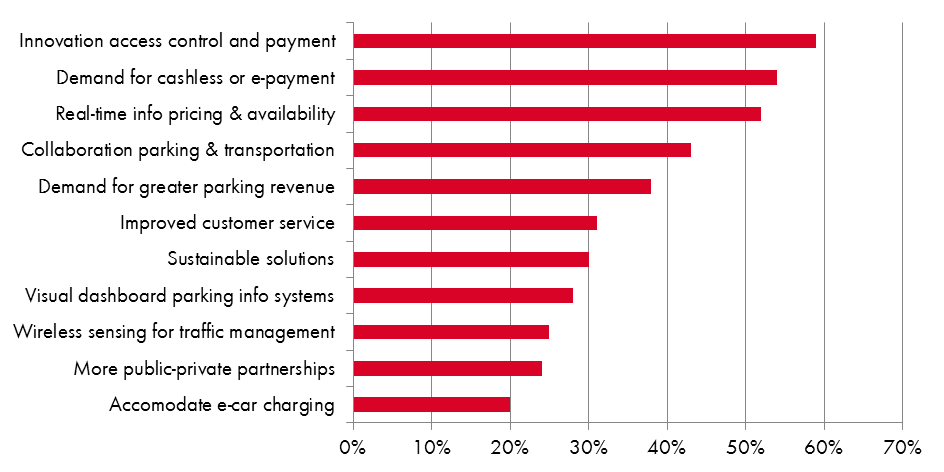
Emerging trends in parking, 2013, IPI
Trends in the car parking market
New technology makes it easier to find a parking space and pay for parking, and to manage this process better. Technology has already changed the parking industry substantially. These developments will continue in the coming years.
- With the continued development of real-time data, those travelling have increasing volumes of information at their disposal, for instance from their in-car navigation systems. This includes the actual availability of parking spaces, a P+R programme with supplementary public transport, and booking parking spaces in advance.
- Cities are developing into smart cities. We are seeing all manner of smart facilities such as wireless traffic management equipment fitted with sensors which helps direct motorists to a vacant parking space. Parking information systems with dashboards are on their way, and perhaps we will see robotised or automated parking in the not too distant future.
- The shift from cash to non-cash payment continues. Queues at payment machines are a thing of the past because more and more people pay automatically by means of identification at the barrier. This was already possible using a credit card but now it is also feasible with an ordinary debit card. Paying for the actual time parked is becoming the standard.
- The number of electric vehicles is rising steadily, along with the demand for charging stations in public parking facilities.
- Cities use every inch of public space. Parking spaces belonging to office blocks are becoming accessible to the public, and outside peak hours these car parks are open to residents with parking permits, as is already the case in Amsterdam.
- The demand for sustainable solutions for the built environment will increase as cities begin to shape their own sustainability policies.
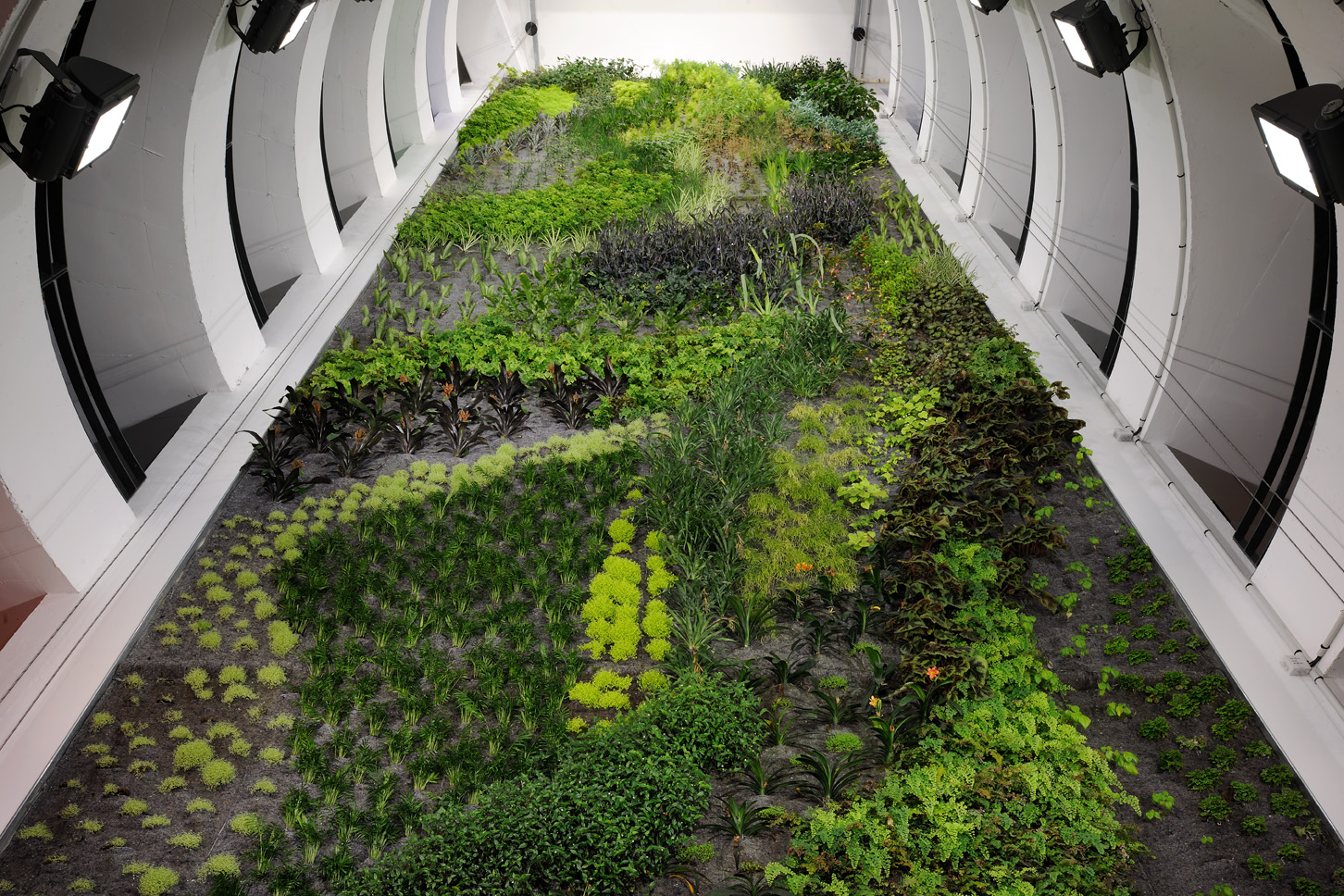
Sustainable solutions for the built environment